











Seoul is one of those cities that never stops surprising you. I’ve lost count of how many times I’ve walked its streets — first in the early 2000s when Itaewon was the traveller’s hub, then again through the Bukchon hanok alleys, the lantern-lit corridors of Insadong, the raw energy of Hongdae at midnight. But Gangnam? For a long time, I wrote it off. Too polished, too commercial, too much of a caricature of itself since that horse-dance video turned it into a global punchline in 2012.
I was wrong. And it took a slow, deliberate afternoon walk — not a rushed tourist sprint — to show me exactly why.
This piece is about exploring Gangnam the right way: not through its designer storefronts or Michelin-starred tasting menus, but through the layers that most visitors completely miss. A 1,200-year-old Buddhist temple sitting silently in the middle of one of Asia’s most expensive real estate markets. A library so surreally beautiful it looks like it was designed for a fever dream. A statue that doubles as an unlikely pop-culture landmark. And, at the end of it all, a Korean BBQ table that reminds you why food is the most honest form of travel.
Why Most Travellers Get Gangnam Wrong
There’s a predictable Gangnam itinerary that circulates on travel forums and YouTube vlogs: Apgujeong Rodeo Street, the COEX Mall, a random café with a pretty interior, and maybe a K-beauty haul. Then it’s off to the next neighbourhood. Two or three hours, max.
The problem with this approach isn’t that it’s bad — it’s that it’s shallow. Gangnam is one of the few places in Asia where hyper-modern urbanism and centuries-old spiritual tradition exist in genuine tension with each other, practically within walking distance. You can stand on a street corner in Gangnam and look left toward a 70-storey glass tower and right toward the roof of a Buddhist temple that predates the Joseon Dynasty. That cognitive dissonance, that contrast, is the story of modern Seoul — and Gangnam is where that story is told most dramatically.
If you skip the slow walk, you miss the whole point.
Stop 1: Bongeunsa Temple – Seoul’s Most Underrated Spiritual Address
Let’s start with the one Gangnam landmark that consistently shocks first-time visitors into silence: Bongeunsa Temple (봉은사).
Founded in 794 CE during the Silla Dynasty, Bongeunsa is over 1,200 years old. Read that number again. 1,200 years. The temple has outlasted dynasties, invasions, fires, reconstructions, and the kind of radical urban transformation that Seoul went through in the second half of the 20th century. And yet here it stands, tucked behind the COEX complex, shaded by pine trees, its incense smoke curling upward into the Gangnam skyline.
Walking into the temple grounds is a genuinely disorienting experience — and I mean that as the highest possible compliment. You enter through the Jinryemun Gate, and within about 30 seconds the ambient roar of the city disappears. The soundscape changes. The pace of everything around you slows.
The most visually arresting feature of the complex is the Mireuk Daebul — a towering standing Buddha statue carved from granite, standing at approximately 23 metres. It dominates the courtyard with a calm authority that’s difficult to describe in writing. You look up at it and feel genuinely small, not in a humbling way, but in the way that good religious architecture has always intended: reminding you that there are things older and quieter than your daily noise.
Beyond the statuary, the temple complex has several wooden halls painted in the traditional dancheong style — bright reds, greens, blues and golds applied in geometric and floral patterns. The Panyajeon Hall houses thousands of carved wooden blocks of the Buddhist scriptures, a collection of extraordinary historical significance. The COEX Lantern Path connecting the temple to the surrounding mall area lights up in the evenings and becomes one of Seoul’s quieter photographic moments — less Instagrammed than Bukchon, somehow more beautiful for it.
A practical note for travellers: Bongeunsa is an active place of worship, not a museum. Monks live and practice here. Dress modestly (shoulders and knees covered), speak softly, and avoid flash photography near devotees during prayer. Temple stays are also available if you want to go deeper — waking at 4am for morning chanting is the kind of experience that rewires you for days.
The temple grounds are free to enter. Give yourself at least an hour here if you’re doing it properly.
The COEX Complex: More Than a Mall
Most guide books treat COEX purely as a shopping destination, which is like visiting the Uffizi and spending your time in the gift shop.
Yes, COEX is enormous — one of Asia’s largest underground shopping malls. Yes, it has an aquarium, multiple food courts, a convention centre, and more fast fashion than any human needs. But it also connects directly to Bongeunsa via the lantern corridor mentioned above, and it houses one of the most quietly spectacular public spaces in all of Seoul: the Starfield Library.
Stop 2: The Starfield Library — Seoul’s Most Photogenic Secret
I’ve been to libraries on six continents. I’ve sat in the reading rooms of the British Library, wandered through the Jorge Luis Borges halls in Buenos Aires, visited the spiral stacks of the Stockholm Public Library at dusk. The Starfield Library inside COEX is not a traditional library in any serious archival sense — it’s a commercial installation, technically operated as part of a retail complex. But as a piece of spatial design, it’s genuinely extraordinary.
The centrepiece is a two-storey atrium lined floor-to-ceiling with bookshelves containing over 70,000 volumes. The shelves tower above you on both sides, accessible via staircases and walkways, framed by warm lighting that turns the spines of thousands of books into something approaching a mosaic. In the middle of the atrium, reading tables are scattered for public use. Anyone can sit here. You don’t need to buy anything.
The visual effect, especially when viewed from the upper walkway looking down, is breathtaking in a way that photographs struggle to fully convey. The sheer vertical scale of the bookshelves, combined with the warmth of the lighting against the darker surrounding mall space, creates a theatrical atmosphere that feels simultaneously intimate and grand.
This is, inevitably, an extremely popular photography spot. Come on a weekday if possible, or early morning on weekends, to have any chance of a clear shot of the atrium without other visitors in frame. Evenings on weekdays can also be relatively quiet.
What I find most interesting about Starfield Library is what it says about Seoul’s relationship with knowledge and aesthetics. It is, on one level, a marketing decision by a retail conglomerate. But the fact that it has become one of the most visited spaces in Gangnam — not for shopping, but simply to sit among books — says something genuinely hopeful about what people are actually looking for when they travel.
Stop 3: The Gangnam Style Statue — Pop Culture as Urban Artefact
A couple of minutes’ walk from the COEX area brings you to something far more playful: the Gangnam Style statue, a bronze sculpture of PSY in his signature horse-riding pose.
I’ll be honest: I was dismissive of this the first time I walked past it. A celebrity statue based on a viral music video didn’t strike me as worthy of a detour. But standing in front of it — watching the range of people stopping to photograph it, from elderly Korean couples to backpackers from Europe to families with young children who weren’t even alive when the song was released — changed my perspective.
“Gangnam Style” was the first YouTube video to reach one billion views. It became a global cultural phenomenon at a moment when K-pop was just beginning its international ascent. Looking back from 2026, it’s easy to see it as the first major crack in the wall — the moment global audiences started paying serious attention to Korean popular culture in a way that foreshadowed the wave that followed: BTS, BLACKPINK, Squid Game, Parasite, and the broader global mainstreaming of the Korean cultural export machine.
The statue, then, isn’t just a silly tourist photo opportunity. It’s a marker of a cultural inflection point. Take the photo, do the pose if you’re so inclined (and most people are), and spend a moment thinking about what Seoul’s cultural influence on the world actually looks like now compared to fifteen years ago.
Stop 4: Korean BBQ — The Meal That Earns Its Place
There is no honest travel piece about Korea that doesn’t eventually arrive at Korean BBQ. It’s not optional. It’s not a cliché. It is, simply, one of the greatest communal dining experiences on the planet.
Gangnam has a significant range of BBQ restaurants, from premium Hanwoo beef establishments charging serious money to unpretentious neighbourhood spots where the meats are excellent and the banchan (side dishes) keep arriving whether you asked for them or not. The best meals I’ve had in this part of Seoul have almost always been at the latter type — the places that don’t have English menus outside, that are packed with local office workers on a Tuesday evening, where the charcoal smoke stings your eyes and the soju comes in small glasses and everyone around you seems genuinely glad to be there.
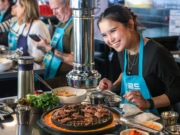
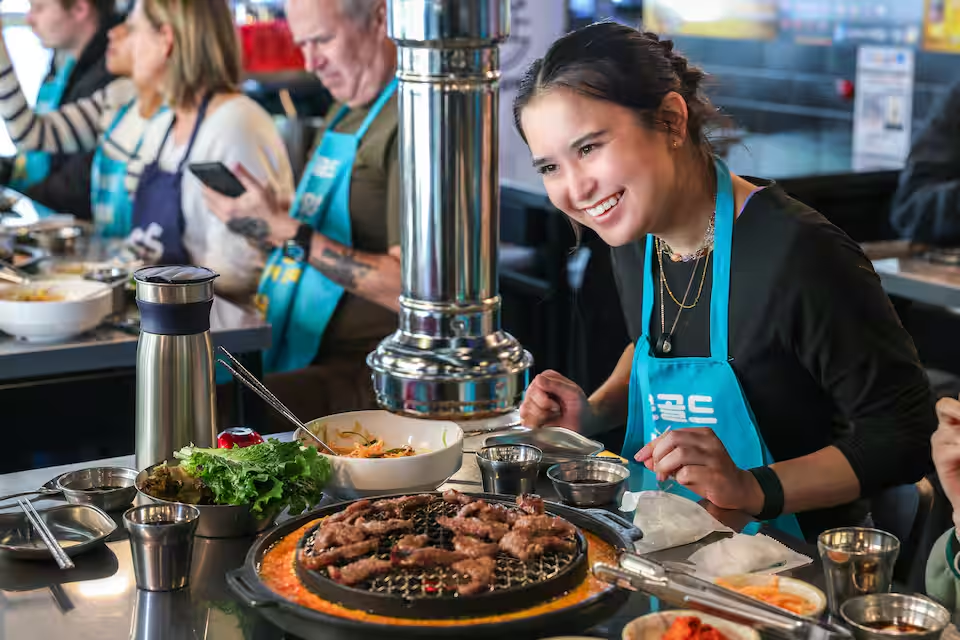
For the uninitiated: Korean BBQ involves grilling meat — typically samgyeopsal (thick-cut pork belly), galbi (marinated short ribs), bulgogi (thinly sliced marinated beef), or chadolbaegi (beef brisket) — on a built-in charcoal or gas grill at your table. You wrap the cooked meat in lettuce or perilla leaves with rice, garlic, sliced chilli, and fermented soybean paste (doenjang). You eat it with your hands. You order more. You have soju or a cold OB lager. The meal is loud, social, fragrant, and deeply satisfying in a way that’s hard to replicate anywhere else in the world.
The side dishes — the banchan — arrive without ordering and typically include kimchi in multiple forms, spinach seasoned with sesame oil, marinated bean sprouts, cubed radish, fish cake, and whatever the kitchen has going that day. These aren’t garnishes; they’re full flavours that balance the richness of the grilled meat.
A practical tip: if you’re eating alone or as a couple, some restaurants have a two-person minimum per order of certain cuts. Don’t let this put you off — order a mixed selection and work through it at your own pace. Solo travellers, in particular, often find that sitting at a BBQ table in Gangnam and letting the evening unfold naturally leads to exactly the kind of spontaneous human connections that make travel worth doing.
Practical Travel Notes for Gangnam
Getting there: Gangnam is served by multiple subway lines. Bongeunsa Station (Line 9) Exit 2 is the most convenient starting point for the route described in this article. COEX is adjacent, and the Starfield Library and Gangnam Style statue are both within comfortable walking distance.
Best time to visit: The route works in any season, but Seoul in spring (late March to early May) and autumn (October to November) is particularly beautiful. Summer brings heat and humidity; winters are cold but clear. The temple is atmospheric in light rain.
How long to allow: A proper, unhurried exploration of all four stops — Bongeunsa, Starfield Library, the Gangnam Style statue, and a proper BBQ dinner — takes a full afternoon and evening. Don’t rush it. This is not a checklist exercise; it’s a way of actually understanding a neighbourhood.
Guided vs. solo: Gangnam is navigable independently, but going with a knowledgeable local guide makes a significant difference — particularly at Bongeunsa, where the historical and religious context transforms a pretty temple visit into something much more meaningful. If you’re looking for a structured way to experience this exact Gangnam route — temple, library, statue, BBQ — this guided Gangnam culture & K-BBQ experience in Seoul is one of the better options for first-timers. A good guide will also steer you away from the tourist-trap BBQ spots and toward the places where the food is genuinely excellent.
What to wear: Comfortable walking shoes are essential. The route involves moderate walking — nothing strenuous, but enough that you’ll feel blisters if you’re in the wrong footwear. Dress modestly for the temple visit.
Why Gangnam Deserves More Than Its Reputation
Here’s the thing about Gangnam that took me years of Seoul visits to properly appreciate: it is genuinely layered in a way that rewards patience.
It is easy to look at Gangnam — at the luxury apartment towers, the dermatology clinics, the plastic surgery billboards, the designer boutiques — and conclude that it’s all surface, all performance, all money. That reading isn’t wrong, exactly. The wealth here is real and the consumer culture is real and the pressure to look a certain way is real.
But Bongeunsa is also real. And it has been real for 1,200 years, long before the tower blocks arrived, long before the K-pop industry existed, long before anyone outside Korea knew what bulgogi was. The temple has watched everything around it change beyond recognition and simply kept going — monks waking at 4am for chanting, incense burning, pigeons roosting on the rooflines.
That combination — the ancient and the ultra-modern existing in genuine proximity, not as a theme park version of each other but as actual co-inhabitants of the same postcode — is what makes Gangnam one of the most interesting urban neighbourhoods in Asia. And the meal at the end, the one that brings you back to your body after a day of sensory overload, is the natural conclusion: the oldest form of human connection, around fire, with food.
Seoul will keep surprising you. Give Gangnam the afternoon it deserves.
Have you explored Gangnam beyond the shopping strips? Drop your experience in the comments — I’d love to know what you discovered.