












I have spent the better part of two decades moving through Southeast and East Asia – from the chaotic warmth of Bangkok’s street markets to the quiet grace of Kyoto’s temple districts, from the neon-lit towers of Seoul’s Gangnam to the colonial-era alleyways of Hanoi’s Old Quarter. What strikes most first-time visitors is the sheer variety. Asia is not a country. It is not even a culture. It is a continent of contrasts, and the traveller who arrives expecting a single experience will be continuously, wonderfully surprised.
This guide is written for the person who is serious about exploring Asia – not as a tourist ticking off Instagram landmarks, but as someone who wants to understand the places they visit, the people they meet, and the cultural rhythms that make each destination unique. Whether you are planning your first trip or your fifteenth, there is something here for you.
Why Southeast Asia Remains One of the World’s Great Travel Destinations
It is tempting to describe Southeast Asia in superlatives – the cheapest food, the most beautiful beaches, the friendliest people. And while those things are broadly true, they flatten what is genuinely a layered and complex region. The countries that sit within this part of the world – Thailand, Vietnam, Cambodia, Malaysia, the Philippines, Singapore, Indonesia – share geographical proximity but diverge sharply in language, religion, cuisine, history, and temperament.
What they share, from a traveller’s perspective, is an extraordinary accessibility. Budget airlines connect most major cities. Visa-on-arrival arrangements have opened many borders. The infrastructure for tourism – guesthouses, transport apps, money exchange, eSIM connectivity – has matured enormously in the past decade.
Speaking of staying connected: if you’re planning a multi-country itinerary across Asia, read this before you fly: Best eSIM for Travel 2026: Top 5 Websites Tested. Physical SIM cards city-by-city are no longer necessary, and getting this right before departure saves hours of frustration on arrival.

Thailand: The Gateway Country and What Lies Beyond the Beaches
Most first-time visitors to Southeast Asia arrive in Thailand, and most of them land in Bangkok. This is the right call. Bangkok is arguably the finest city in Southeast Asia for a traveller’s orientation – chaotic enough to wake you up, functional enough to keep you grounded, and layered with enough culture, food, and history to keep you engaged for a week before you’ve even left the city limits.
Beyond Bangkok, the country spreads into distinct regions each with its own character. The north – Chiang Mai, Chiang Rai, Pai – offers a cooler, greener, more traditionally Thai experience, with night markets, temple circuits, and trekking into hill-tribe villages. The south splits between the Andaman Coast (Krabi, Phi Phi, Koh Lanta) and the Gulf side (Koh Samui, Koh Phangan), each with its own sea and scenery.
Phuket, which sits on the Andaman side, deserves its own note. It is one of the most internationally connected resort destinations in Asia, and its social scene draws a wide mix of travellers. If you’re considering dating in Phuket as a Westerner, the Asia Dating Guide breaks down exactly what that experience looks like – the where, the how, and the cultural nuances that determine whether meaningful connections are made.
Practical Thailand Travel Notes
• Best time to visit: November to April (dry season, especially for the south)
• Currency: Thai Baht (THB). ATMs are widely available but charge foreign card fees – consider bringing USD to exchange
• Getting around: Grab app works in most cities; overnight trains between Bangkok and Chiang Mai are excellent value
• Food safety: street food is generally safe and far superior to tourist-restaurant approximations of Thai cooking
Vietnam: A Country That Rewards the Slow Traveller
Vietnam stretches over 1,600 kilometres from north to south, and the temptation is to race through it – Hanoi to Hoi An to Ho Chi Minh City in two weeks, ticking off the big names. The travellers who resist this temptation, who slow down and stay in one place long enough to understand its rhythm, tend to find Vietnam unforgettable.
Hanoi, in the north, has an older, more French-influenced character. The Old Quarter’s 36 Streets each historically specialised in a specific trade – silk, paper, tin, bamboo – and the neighbourhood still functions with a street-level energy that is genuinely distinct from any other city in Southeast Asia. The south, anchored by Ho Chi Minh City (still called Saigon by most of its residents), is faster, more entrepreneurial, more obviously modern.
Between north and south lies the stretch of central Vietnam – Hue, Hoi An, Da Nang – that represents, for many travellers, the country’s most photogenic and culturally concentrated region. For those considering longer stays and social connection in the country, this guide to the best cities in Vietnam to meet people gives a city-by-city breakdown with local context that most tourist guides skip entirely.
If you’re exploring Southeast Asia more broadly – Thailand, Cambodia, and Vietnam in a single trip – this Southeast Asia travelogue from Top Five Buzz gives a ground-level perspective on moving between the three countries.

Malaysia and Singapore: The Modern Asia Experience
If the beach-and-temple trail of Thailand and Vietnam represents one version of Asia, Malaysia and Singapore offer a contrasting vision – a confident, contemporary, multilingual Asia where modern infrastructure meets deep ethnic and cultural diversity.
Singapore, the city-state at the southern tip of the Malay Peninsula, is arguably the most liveable and navigable city in Asia for a Western visitor. The MRT system is world-class. English is spoken everywhere. Food courts – known as hawker centres – serve extraordinarily good food at extremely low prices relative to the city’s overall cost of living. The National Gallery, Gardens by the Bay, and the Peranakan neighbourhoods of Katong and Joo Chiat offer cultural depth that the glittering skyline can distract from.
The social scene in Singapore is a study in contrasts – simultaneously international and deeply locally rooted. For Western men navigating the social landscape in Singapore as a foreigner, Asia Dating Guide covers the unwritten codes, the expectations around intention, and where social life actually happens beyond Orchard Road.
Kuala Lumpur, Malaysia’s capital, is often treated as a transit hub rather than a destination – which is a mistake. The city’s food scene, anchored by its extraordinary ethnic diversity (Malay, Chinese, Indian, and Peranakan cuisines all present), is among the best in Asia. The colonial-era Brickfields neighbourhood sits minutes from the futuristic Petronas Towers, and the juxtaposition is characteristic of a city that has never quite decided what it wants to be – which is precisely what makes it interesting.
If Kuala Lumpur is on your itinerary and you’re thinking about how social life works there beyond the tourist circuit, the guide to dating in Kuala Lumpur as a Westerner is a frank and useful read on navigating the city’s multicultural social dynamics.
East Asia: South Korea, Japan, and Taiwan
East Asia operates at a different frequency from Southeast Asia – more structured, more formally organised, with cities that are extraordinarily efficient and cultures that place a high premium on social harmony and group cohesion. For a Western traveller, the adjustment can take a few days, but the rewards are considerable.
South Korea: Seoul and Beyond
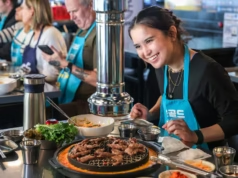
Seoul is, by any measure, one of the great world cities. The Han River bisects it; subway lines reach almost everywhere; the food – from street tteokbokki to high-end Korean barbecue – is extraordinary. Most visitors spend their time in Hongdae, Insadong, or Myeongdong, all of which are worth visiting. But the district that consistently surprises travellers who make time for it is Gangnam.
Beyond the K-Pop associations and luxury retail, Gangnam contains Bongeunsa Temple – a 1,200-year-old Buddhist site surrounded by glass towers – and the Starfield Library inside COEX Mall, which has become one of Seoul’s most visited spaces for reasons that have nothing to do with shopping. For a deep dive, read: Gangnam Beyond the K-Pop Glam: Temples, Hidden Libraries & the BBQ You Didn’t Know You Needed.
Japan, meanwhile, rewards any amount of time you give it. From the 12 most famous tourist spots in Japan – Senso-ji in Asakusa, the Fushimi Inari Shrine, Kinkaku-ji’s golden pavilion – to the less-travelled places like the Jigokudani Snow Monkey Park in Nagano, the country has a remarkable density of things worth seeing.
Taiwan’s capital Taipei occupies an interesting position in East Asia – smaller than Seoul or Tokyo, less internationally known, but exceptionally liveable and culturally rich. If you’re thinking about spending extended time in Taipei, the guide to Taipei as a Westerner covers the social landscape with clarity and specificity.
Before You Go: Health, Logistics, and the Practical Essentials
Eighteen-plus years of Asia travel have taught me that the difference between a trip that goes smoothly and one that doesn’t usually comes down to preparation done before departure, not decisions made in the moment.
Health Preparation
Mosquito-borne diseases are a reality in many parts of Southeast Asia, particularly in rural areas and during monsoon season. Japanese Encephalitis, malaria, and dengue are all present in specific regions. Before any Southeast Asia trip, consult a travel health clinic at least six weeks before departure – some vaccines require multiple doses spread over weeks.
For more on health considerations specific to Asia travel, including vaccine schedules and high-risk activity profiles, this resource on Japanese Encephalitis travel advice before visiting Asian countries covers the key points travellers often miss.
Flights and Getting Around
Finding genuinely cheap flights to Asia requires knowing where to look. There are significant price differences between booking platforms, and flexible travel dates can produce savings of hundreds of dollars. This breakdown of the 20 best flight search engines for international travel remains one of the most comprehensive resources for this.
Once in-country, budget airlines – AirAsia, VietJet, Jeju Air, Scoot – connect most major cities within Southeast and East Asia at very low cost, particularly when booked in advance. Overnight bus and train services between cities in Thailand, Vietnam, and Malaysia are generally comfortable, safe, and offer the advantage of saving a night’s accommodation.
Connectivity
The era of hunting for a local SIM card at every border crossing is over. eSIM technology now allows travellers to activate regional or country-specific data plans before departure, from their phone, without visiting a physical shop. This tested guide to the best eSIM providers in 2026 ranks the top five services by speed, price, and reliability across Asia, Europe, and the Americas.
Understanding Asian Culture: What Every Traveller Should Know
No travel guide can fully prepare you for the cultural learning curve that comes with extended travel in Asia. What it can do is flag the areas where misunderstandings most commonly occur, so you arrive with useful frameworks rather than arriving blank.
The Role of Family
Across much of Asia – from Japan to the Philippines, from South Korea to Vietnam – family is not simply a personal matter but a social institution that shapes decisions about career, living arrangements, relationships, and personal identity in ways that can seem striking to travellers from Western backgrounds.
This manifests differently country by country. In Japan, it shows up in the weight placed on not embarrassing one’s family – a concept that shapes everything from workplace behaviour to personal relationships. In Southeast Asia, it often means that adult children live with their parents well into their twenties and thirties, and that parental approval of significant life decisions is actively sought rather than politely acknowledged.
For those interested in the deeper dynamics of relationships across cultural lines in Asia – the expectations, the communication styles, the role of family approval – Asia Dating Guide’s foundational content approaches these questions with the kind of specificity and cultural honesty that general travel guides rarely provide.
Communication and Face
The concept of ‘face’ – broadly, one’s social reputation and dignity in the eyes of others – operates as a real and powerful social force across most of East and Southeast Asia. Causing someone to lose face, even inadvertently, can damage a relationship irreparably. Preserving face – both your own and others’ – is not about dishonesty; it is about navigating social situations with care and awareness.
Practically, this means that direct confrontation is generally avoided. A ‘yes’ in many Asian contexts does not necessarily mean agreement – it often means ‘I have heard you and I do not wish to embarrass you by disagreeing.’ Learning to read indirect communication, to notice what is not said as much as what is, is one of the most valuable travel skills you can develop in Asia.
Volunteering: The Deeper Way In
For travellers looking for a way to engage with Asia beyond the tourist experience, volunteering offers a genuinely different kind of access. Countries like Nepal, Cambodia, Thailand, Vietnam, and the Philippines have structured volunteer programmes in education, conservation, and community development. This guide to volunteering in Asia covers what to expect, which countries offer the most organised opportunities, and how to ensure your contribution is genuinely useful rather than performative.
Hong Kong: Asia’s Most Layered City
No roundup of Asian travel is complete without Hong Kong. The city operates at a density and intensity unlike anywhere else on the continent – seven million people compressed onto a series of islands and a thin strip of mainland, connected by one of the finest public transport systems in the world.
The cultural experience in Hong Kong is distinctively its own: Cantonese culture filtered through 155 years of British colonial history, now operating under a different political arrangement but still deeply shaped by that particular combination. The food – dim sum for breakfast, roast goose in the evening, egg tarts at any point in between – is extraordinary. The hiking, which visitors consistently underestimate, takes you out of the urban density and into green hills with sea views within thirty minutes of the city centre.
The social life in Hong Kong is famously fast-paced, and the city’s dating culture reflects that speed. For the specifics of navigating social connection in Hong Kong as a foreigner, Asia Dating Guide covers the cultural dynamics, the expectations, and the practical landscape in a city that is simultaneously one of Asia’s most cosmopolitan and most locally distinct.
The Asia You’ll Find Is the Asia You’re Looking For
After nearly two decades of returning to Asia – as a solo traveller, as half of a travel couple, as a filmmaker, and increasingly as someone who finds the continent’s complexity genuinely inexhaustible – what I know is this: Asia rewards curiosity.
The traveller who arrives with genuine openness – who is willing to eat something unfamiliar, to sit with a language they don’t speak, to accept that the social codes operating around them are not inferior to their own but simply different – is the traveller who comes home changed.
The cities covered in this guide are starting points. Each one has depths that a single visit barely scratches. Some of them – Bangkok, Hanoi, Seoul – I have returned to more times than I can accurately count, and each time I find something I missed.
Travel Asia slowly if you can. The slow version of this continent is infinitely richer than the fast one.
─────────────────────────────────
About the Author
Debarup Mukherjee is a travel blogger, cinematic vlogger, and documentary filmmaker from India with over 18 years of experience travelling across Asia and internationally. He runs the travel blog Top Five Buzz and two YouTube channels – Debrup Travel Films (Hindi/English cinematic travel documentaries) and Bong Travel Planner (Bengali-language travel vlogs). His work focuses on authentic, in-depth travel content that goes beyond surface-level tourism.
Related Searches on Asia Dating Guide:
• Dating in Phuket as a Westerner
• Dating in Singapore as a Foreigner
• Dating in Kuala Lumpur as a Westerner
• Dating in Taipei as a Westerner
• Dating in Hong Kong as a Foreigner
The Best Cities in Vietnam to Meet Women